About the book “Through the Looking-Glass and what Alice found there”
Quick facts
- Full title: Through the Looking-Glass and what Alice found there
- Author: Lewis Carroll (pen name of Charles Lutwidge Dodgson)
- Illustrator: Sir John Tenniel
- Publishing date: December 1871 (but dated 1872)
- Publisher: Macmillan
- Place of publication: Oxford
- Translated: in more than 65 languages
The creation of the story
While writing the ‘Looking-Glass’ story, Charles Dodgson (Lewis Carroll) used a lot of material that he had come up with earlier. In the article ‘Alice on the Stage‘ he remarked:
“[Through the] Looking-Glass [was] made up almost wholly of bits and scraps, single ideas that came of themselves.”
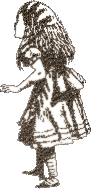
In the six years since he wrote Alice in Wonderland, Carroll had been teaching Alice and her sisters the game of chess. He made up stories to illustrate the moves of the pieces and the rules of the game. Many of these stories were also used for his second ‘Alice’ story. He tied the chess stories and the other individual ideas together into a single story with the use of two main themes: chess and mirror images.
Carroll’s distant cousin Alice Raikes suggested that she gave him the idea for the Looking-Glass theme, when he asked her to stand in front of a mirror, holding an orange, and tell him in which hand she was holding it. However, Carroll met Alice Raikes in August 1868, when the story was already well advanced, so this story is doubtful (Carroll x).
The ‘wrong-way-round idea’ dominates the book, because this kind of game was a favourite of Carroll’s. He liked to write letters in mirror-writing, drew pictures which changed into different ones when held upside down, and he also liked to play his musical boxes backwards. Some people think that this has something to do with his left-handedness, and the asymmetry of his body. Carroll considered having several pages of the book actually printed in reverse, so the reader would have to hold them up to a looking-glass to read, but in the end this proved to be too expensive and troublesome, and only the first stanza of ‘Jabberwocky’ was reversed.
Unfortunately, Carroll’s manuscript of the book did not survive, so contrary to the manuscript of “Alice’s Adventures Under Ground”, it is not available in print. We do have an early list of chapter titles, excised galley sheets, and various comments in letters available to see how the story developed before publication. The first chapter was originally titled “The Glass Curtain” before it became “Looking-Glass House”, and Carroll also considered this as the title for the book (Demakos, 2024, p.2). Originally, the story contained a chapter called ‘A wasp in a Wig‘, but Carroll decided to drop it before publication.
Apparently Carroll never considered writing another ‘Alice’ book after publishing “Through the Looking-Glass”. In a letter to the editor of St. James’s Gazette, dated January 9 1890, he wrote:
There are no ‘dreams’ in [Sylvie and Bruno]: the many imitations, that have appeared, of my two ‘dream-stories,’ have effectually barred me from any further attempt to write fiction of that kind.
Publication
On 24th August 1866, Carroll wrote to Macmillan that he was contemplating another ‘Alice’ book:
“It will probably be some time before I again indulge in paper and print. I have, however, a floating idea of writing a sort of sequel to Alice, and if it ever comes to anything, I inted to consult you at the very outset, so as to have the thing properly managed from the beginning.”
On 6th February 1867, his ideas had become more concrete, as he wrote to his publisher:
“I am hoping before long to complete another book about Alice.”
However, he apparently only started with the actual writing in January 1868. The progress was slow: he completed and sent the first chapter to Macmillan in January 1869 – a year later. The text was complete by 4 January 1871 (Jaques and Gidders 40-41).
Carroll tried to secure an illustrator from the very start of writing the book. Unfortunately, the process of finding an illustrator and creating the illustrations for Through the Looking-Glass was very slow and cumbersome. Eventually he did manage to contract John Tenniel again to create the illustrations.
Not only was the number of illustrations expanded during the process (from 42 to 50), the number of chapters was as well. Some proof sheets printed in 1870 indicate that the book originally had only 11 chapters. Chapter X (‘Waking’) was later divided into two: ‘Shaking’ and ‘Waking’ (Wakeling, 28).
Carroll wanted to publish the book in time for Easter, but this proved to be impossible because of Tenniel’s slow progress. The second date, Michaelmas, also passed by. Carroll eventually decided that it was to come out as a Christmas book.
Printing began in October 1871. On 1 November, Carroll received five proof sheets. On 21 November 1871, Carroll sent authorization to Clay by telegraph to electrotype ‘all the rest of the Looking-Glass. I afterwards sent two corrections by post. So ends my part of the work. It now depends on the printers and binders whether we get it out by Christmas.’ (Wakeling, 26)
On 30 November 1871, Macmillan advised Carroll that they already had orders for 7,500 copies: 9,000 were to be printed and a further 6,000 were ordered.
“Through the Looking-Glass and what Alice found there” was published in December 1871 (but was dated 1872), indeed in an edition of 9,000 copies. The exact day of publication is unknown, but according to Macmillan’s ‘Editions book’, the first printing occurred on 18 November 1871 (Imholtz). Carroll received the first complete copy on 6 December (Wakeling, 26). Based on the dates of advertisements and reviews, we can deduce the book was likely available for sale to the public on 14 December (Lovett). As with Alice’s Adventures, copies were bound in red cloth gilt, with the date and number of the ‘thousand’ on the title page.
The second print run consisted of 6,000 copies. By 27 January 1872, 15,000 copies of the story (both print runs) had been sold. There was so much demand that Macmillan struggled to keep up the production, and the book shortly went out of stock before Christmas (Imholtz).
The third and fourth print runs were to be 4,000 (printed in November 1871) and 1,000 (February 1872) copies (the sixteenth to twentieth thousands). Sales kept going well, as in 1872 the 25th thousand was reached (Demakos, Bounding Brooks, 13). However, there are no copies found today that bear these thousands-marks. It is possible that Macmillan failed to keep proper track of the correct numbering.
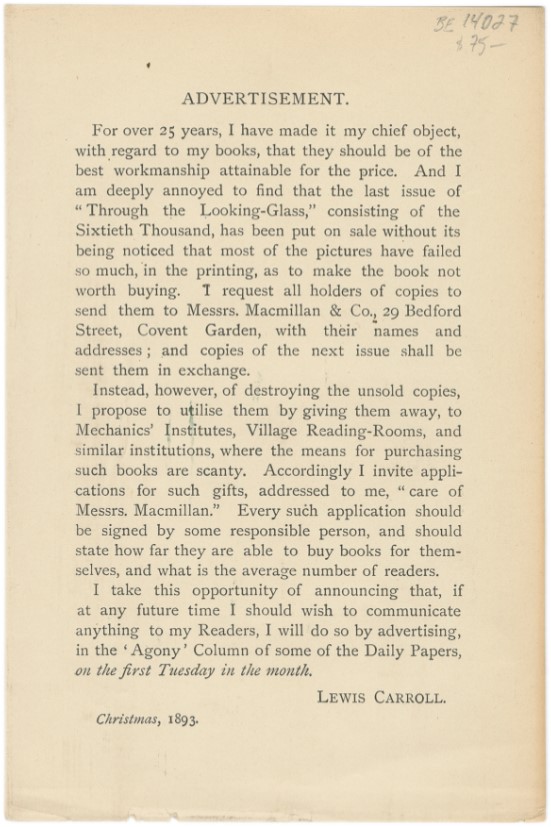
Carroll’s advertisement about the 1893 misprint
Many copies were printed for the purpose of shipping them to the US, and these copies are included in the thousands-numbering: the thirty-ninth thousand (November 1875) has a New York imprint, the forty-second thousand (July 1877, but also dated 1878 and 1880) has a joint imprint (London and New York) and a different binding. The fourty-third and fourty-fourth have a dual imprint as well, but were never shipped from the UK (Imholtz).
The second edition was published in 1878, and started with the 45th thousand.
In 1893, the third edition was reprinted again (the 60th thousand). Carroll recalled the entire printing because he thought the illustrations looked bad, which makes this edition very rare now (Hancher 219). This fiasco made Carroll lose all confidence in printer Clay, and he seriously considered changing printers (Demakos, Cut-proof-print 43)
The book reached the 70th thousand in 1932. The last reprint was in 1942.
It is estimated that about 62,000 copies of “Through the Looking-Glass and what Alice found there” were sold in the UK in Dodgson’s lifetime (Imholtz).
In 1887, Macmillan issued cheaper versions of “Through the Looking-Glass and what Alice found there”, styled as ‘People’s Edition’ in green pictorial cloth.
The British copyright on “Through the Looking-Glass” expired in 1948.
Textual revisions
After publishing the story, Carroll kept improving it, just as he did with “Alice’s Adventures in Wonderland”.
The first edition of “Through the Looking-Glass” contained a misprint on page 21: “Wade” instead of “Wabe”, which was corrected in later editions.
One of the more notable changes by Carroll is his description of the Red Queen, which was changed from “She’s one of the thorny kind” to “She’s one of the kind that has nine spikes, you know”. This may be a removal of a reference to a person Carroll knew: the governess of the Liddell children, nicknamed ‘Pricks’.
Only six years after publication, Carroll discovered an error in the chess diagram. Apparently both kings had been omitted from the 25th thousand until the 42th thousand edition, meaning it already occurred in the first year of publication! (Demakos, Bounding Brooks, 13)
In the 1890s he made major revisions, which were incorporated in the 61st thousand edition of ‘Through the Looking-Glass’, which was published in 1897 (Goodacre, “The works of”). Carroll replaced his preface, and also removed the Dramatis Personae. This last red-cloth edition had incorrect page numbers for all the chess moves listed under the chess diagram. The error wasn’t corrected until after the 45 years. (Demakos, Bounding Brooks, 13)
See Goodacre’s “The Textual Alterations for the 1897 6s Edition of Through the Looking Glass” for a complete list of changes.
Title
The title of the book was much discussed by Carroll. The working title of Alice’s new adventures was ‘Looking-Glass House’. It evolved to ‘Behind the Looking-Glass, and what Alice saw there’, which Dodgon mentioned in a diary entry from January 1869.
In 1870 a specimen title page was produced that mentioned “Looking-Glass House, and What Alice Saw There”.
Macmillan wrote to Carroll in March 1870: “as to the main title I decidedly prefer the first form of words: “Behind the Looking-Glass.” “Looking-Glass World” is too specific.”, and later responded to another letter of Carroll: ““Through” is just the word – you’ll never beat it.”
Eventually Carroll’s friend Henry Liddon suggested the final title ‘Through the Looking-Glass, and What Alice Found There’ (Jaques and Gidders 41).
In a letter to his publisher, dating 19 March 1875, Carroll wrote that he had “another” idea for the title, namely “Jabberwocky and Other Mysteries, Being the Book That Alice Found in Her Trip Through the Looking-Glass”. He wanted everything to be in reverse printing, except ‘Jabberwocky’ (Borchers).
Translations
The story has been translated into 65 languages, and 1,530 different editions were identified all over the world in 2015. The number keeps increasing (Lindseth and Tannenbaum).
Works cited
Borchers, Melanie. “A Linguistic Analysis of Lewis Carroll’s Poem ‘Jabberwocky'”, The Carrollian, no. 24, dated Autumn 2009, published November 2013.
Carroll, Lewis. “Reflecting Alice. A Textual Commentary on Through the Looking-Glass“. Introduction and annotations by Selwyn Goodacre, Evertype, 2021.
Demakos, Matt. Cut-Proof-Print. From Tenniel’s Hands to Carroll’s Eyes. Stuffing the Teapot Press, 2021.
Demakos, Matthew. The Annotated Song of the White Knight. Errant Illuminations on Lewis Carroll’s Farcical Ode. Stuffing the Teapot Press. 2024
Demakos, Matthew. “Bounding Books & Hopping Hedges. Looking-Glass chess for beginners”. Knight Letter, volume III issue 9 no.109, fall 2022.
Goodacre, Selwyn. “The Textual Alterations for the 1897 6s edition of Through the Looking Glass”. The Carrollian, issue 22, dated Autumn 2008, published September 2011.
Goodacre, S. et al. “The Works of Charles Dodgson: Alice”. The Lewis Carroll Society, 10 July 2017, lewiscarrollsociety.org.uk/pages/aboutcharlesdodgson/works/alice.html.
Hancher, Michael. The Tenniel illustrations to the ‘Alice’ books. The Ohio State Press, second edition, 2019.
Imholtz, Clare. “Notes on the early printing history of Lewis Carroll’s ‘Alice’ books”. The Book Collector. Volume 62, no. 2, summer 2013.
Jaques, Zoe and Eugene Gidders. Lewis Carroll’s Alice’s Adventures in Wonderland and Through the Looking Glass. A Publishing History. Ashgate Studies in Publishing History, Ashgate Publishing, 2016.
Lindseth, J.A. and A. Tannenbaum. Alice in a World of Wonderlands. Oak Knoll Press, 2015.
Lovett, Charlie. “The Publication Date of Through the Looking-Glass“. Knight Letter, Volume III issue 6* no.106, spring 2021, p.14.
Wakeling, Edward. “The Illustration Plan for Through the Looking-Glass“. The Carrollian, nos. 35 & 36, December 2021.