About Disney’s “Alice in Wonderland” 1951 cartoon movie
In 1951, Walt Disney released a cartoon movie titled ‘Alice in Wonderland’. It was not the most successful Disney movie, but many people remember it still.
Walt Disney always has been fond of Lewis Carroll’s books. He once said:
“No story in English literature has intrigued me more than Lewis Carroll’s Alice in Wonderland. It fascinated me the first time I read it as a schoolboy, and as soon as I possibly could, after I started making animated cartoons, I acquired the film rights to it.”
(source)
Walt Disney loved the Alice books, probably because Lewis Carroll appreciated childhood, with which Disney totally agreed. He also once said:
“Too many people grow up. That’s the real trouble with the world, too many people grow up. They forget. They don’t remember what it’s like to be 12 years old. They patronise, they treat children as inferiors. Well I won’t do that.”
How the movie started
In 1920 Walt Disney had produced ‘the Alice Comedies’; his shorts which had given him his first success. They were about a real girl named Alice, who walked around in a drawn world. Since that time he had decided that he was going to make a film based on Lewis Carroll’s story.
 Walt Disney purchased the rights to the Tenniel illustrations in 1931. He considered a live-action/animation version of the story, starring Mary Pickford as Alice, and in 1933 some color screen tests were made of her. Disney then shelved the project, because of Paramount’s 1933 live-action adaptation.
Still, Disney was not entirely put off and picked up the movie later. He registered the title with the Motion Picture Association of America in 1938 and hired storyboard artist Al Perkins and art director David S. Hall to develop the story and concept art for an all-animated film. A story-reel was complete in 1939, but Disney felt that Hall’s drawings resembled Tenniel’s drawings too closely, which made them too difficult to animate. Also, he found that the overall tone of Perkins’ script was too grotesque and dark. Because of the amount of work the movie needed and because of World War II, the project was again put on hold.
Disney seriously started producing of the movie until June 1947. He assigned British author Aldous Huxley to re-write the script. Again, Disney was not satisfied: he felt that Huxley’s version was too much of a literal adaptation of Carroll’s book. He did however like the designs of background artist Mary Blair, because they did not resemble the sketchiness of Tenniel’s illustrations and made use of bold colors. The script was then re-written to focus on comedy, music, and the whimsical side to Carroll’s book. (source)
Actors
Disney changed his mind about who was going to star in this film several times. In 1933, there was talk about the girl who had worked with Disney in those Alice shorts, starring as Alice. Then in 1945, Disney announced that Ginger Rogers was going to be the star and then a young girl named Luana Patten. Lisa Davis Waltz was also considered.
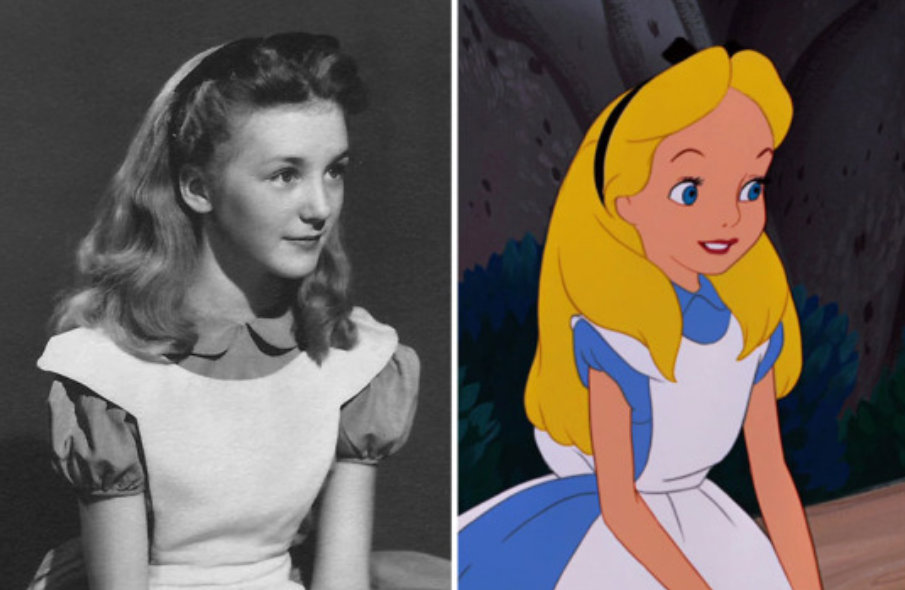
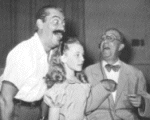
Finally, after more than 200 young actresses were auditioned, a 14-year-old girl named Kathryn Beaumont was picked to play the part of Alice.
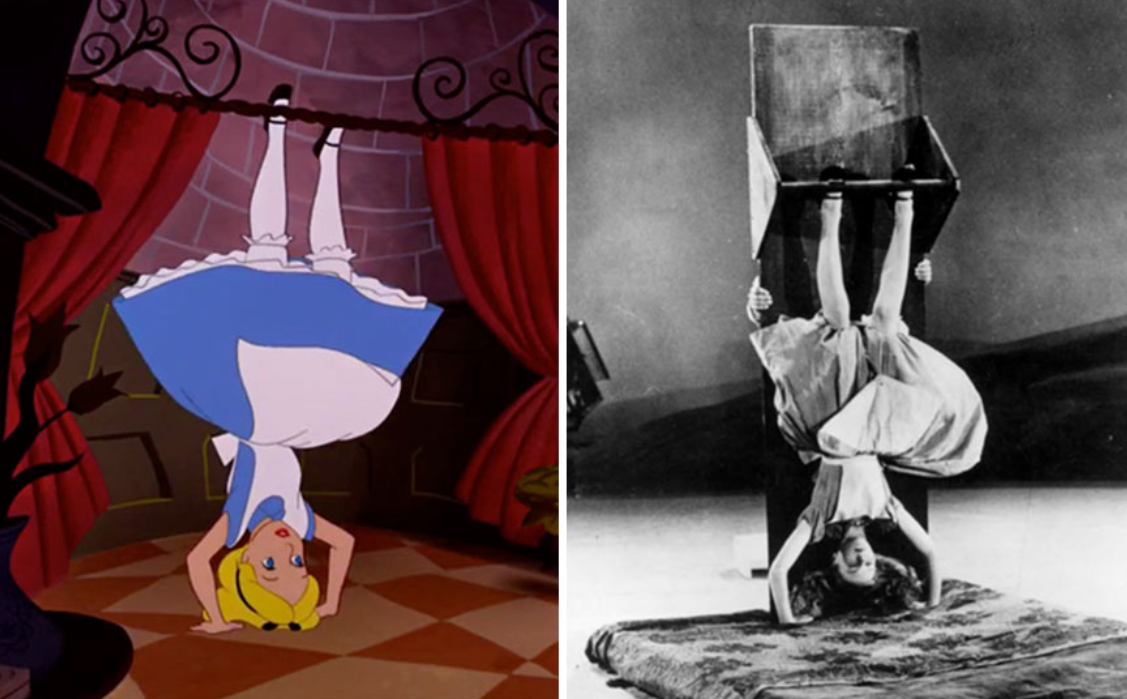
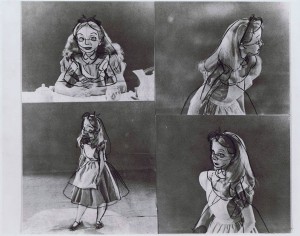
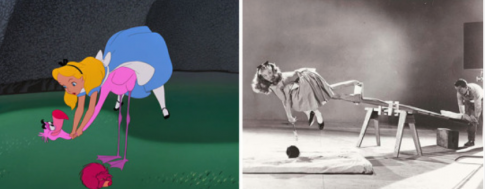
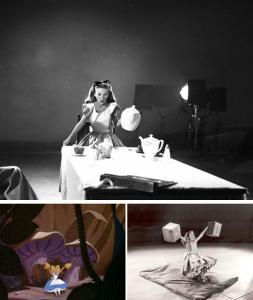
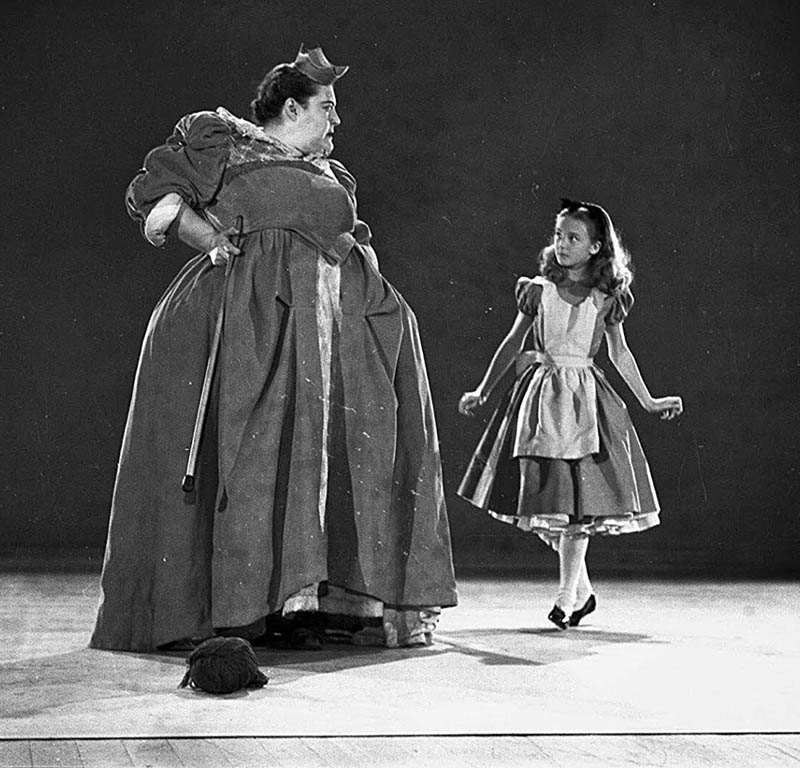
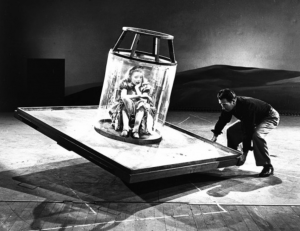
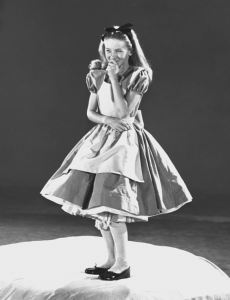
It was also after her that Disney’s Alice was modeled, because she not only provided her voice, but she (as did several other voice actors) also acted out the role in live-action footage filmed for the animator’s reference, wearing a specially created Alice costume.
Storyline
Disney recognised that due to running time constraints and continuity demands he needed to scale the story down a bit. Although he did not originally intend to cut too many sequences, he realized that many characters would have to be eliminated, or else have their screen time reduced. This is why Disney combined scenes from both ‘Alice’s Adventures in Wonderland’ and ‘Through the Looking-Glass’ for the story-line, and characters like the Griffin, the Mock Turtle, the Duchess, the Jabberwock and Humpty Dumpty (“he was too talky”) did not pass the cutting floor and were left out.
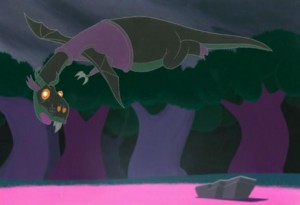
The Jabberwock scene was cut from the movie. Therefore, the Cheshire Cat’s song “I’m Odd” was also cut and he was made to sing “Jabberwocky” in stead.
He did try to create amalgams in his characters though; for example scenes of the Duchess were merged into those of the Queen of Hearts, and the Cheshire Cat was to sing ‘Jabberwocky’.
The only main character that was made up by Disney was the talking Doorknob. The Doorknob was created “in order to avoid a long explanatory monologue at the beginning of the story and to give Alice a foil to talk to.” Disney had originally given a voice and personality to the “Drink Me” bottle, replacing one inanimate object with the other with the creation of the talking Doorknob (source).
For more details, read the article “How I cartooned ‘Alice'” – an interview with Walt Disney in which he explains what problems he encountered, which decisions he made, and why, when creating the cartoon movie.
Many songs were written for the movie, most ones being based on Carroll’s poems. As with the scenes, many of these songs did not make it into the movie. On the Disney Wikia site you can read which songs were not used and which scenes were cut.
Character visualisation
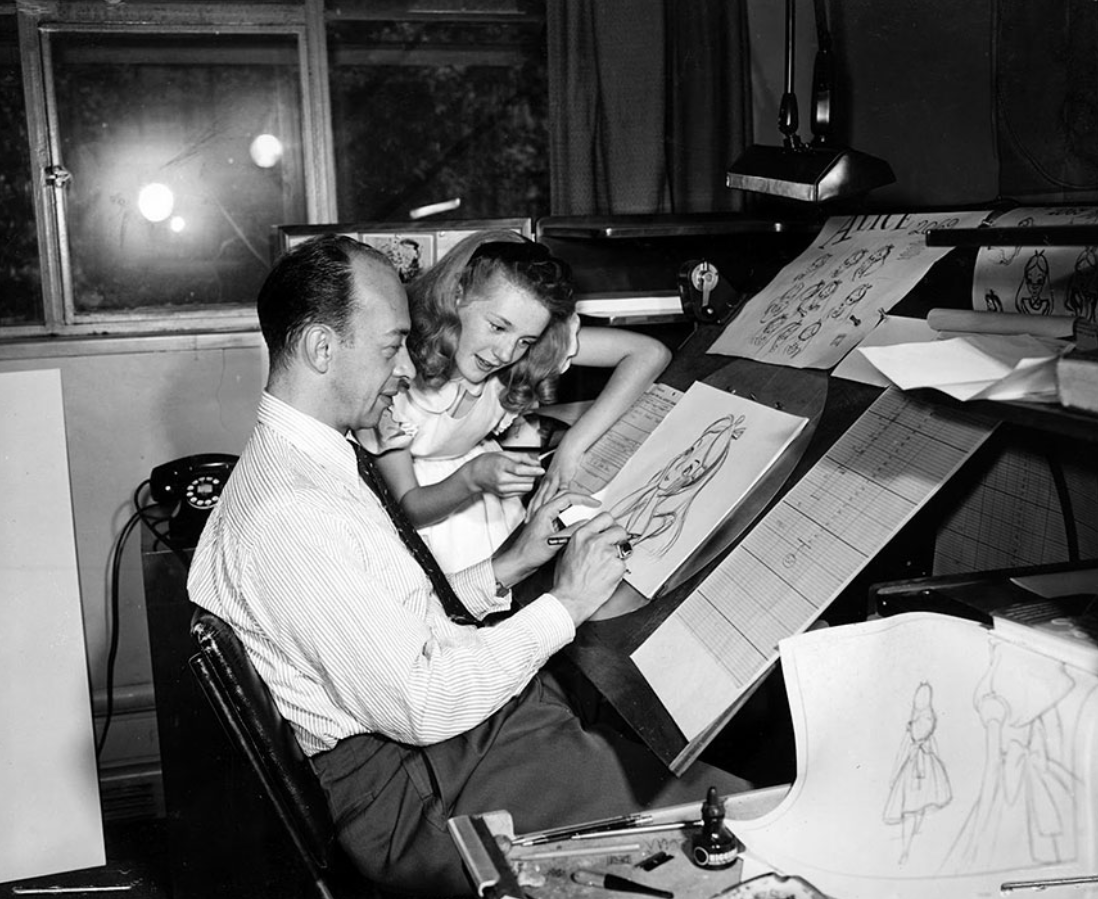
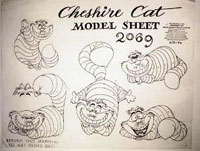 Because Sir John Tenniel’s illustrations for the Alice books were so well known, Walt Disney acquired the rights to them as the basis for the characters of his movie.
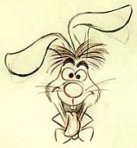
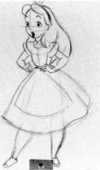
However, the complex pen and ink designs did not lend themselves to animation. Instead, the animators used the original drawings as a starting point, but gave them a Disney make-over.
It required months of rough sketches before the model sheets, which would guide the animators, were finished.
The inspirational paintings that Mary Blair created, deeply influenced the final visualization of the movie and its characters.
Production
 The production of Alice in Wonderland began in 1946. The film took five years to finish and it cost the studio about $3 million, partly because a full-length live action film was shot so that animators could consult it while animating the film.
Using profits from his 1950 animated success ‘Cinderella’, Disney was able to get for ‘Alice in Wonderland’ some of the top talents of the era as voice talent, the largest musical score of any Disney classic, elaborate backgrounds and visual styling (by Mary Blair), as well as Salvador Dali influenced animation sequences.
The movie was released in theaters on July 26, 1951.
After the release
 When Alice in Wonderland was finally released, however, the audiences were disappointed. They felt that Disney had failed to capture the atmosphere and intellectual humor of Lewis Carroll’s story.
Disney too was disappointed with the film and blamed it’s lack of success on Alice’s “lack of heart”. He was also dissatisfied because he still thought there were too many characters playing in it.
The only success brought about by the movie was the music. “I’m Late” and “The Unbirthday Song” were two songs that became quite popular with the public.
Watch the original movie trailer:
Some trivia:
- The music for “Alice in Wonderland” was provided by a 50 piece orchestra.
- In 1952 Oliver G. Wallace was nominated for an Academy Award for Best Scoring of a Musical Picture.
- “Alice in Wonderland” is composed of more than 350,000 drawings and paintings.
- From 1949 to 1951, more than 750 artists worked on the movie.
- Eight hundred gallons of special paint, weighing nearly five tons, were required to paint the animated frames, and that’s enough paint to cover the exteriors of 135 average homes!
- More than 1,000 different shades of watercolor were used to capture the mood of Wonderland.
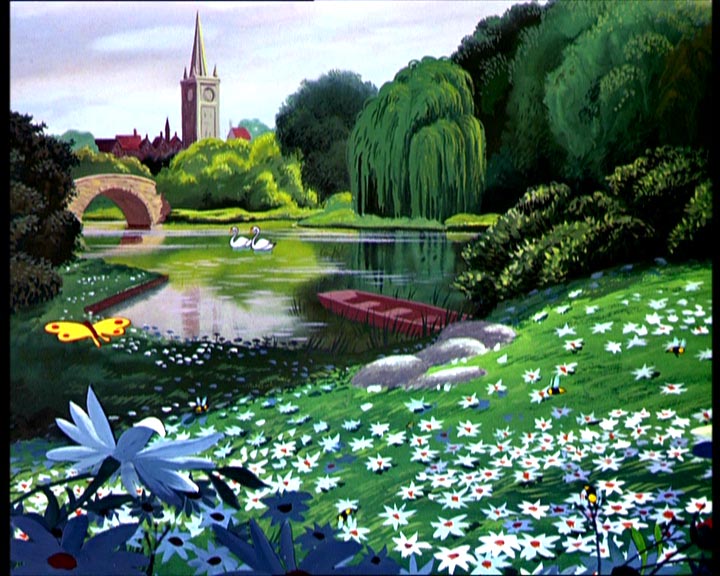
- The opening scene pays a small homage to the origins of the story, by showing a rowing boat with Oxford’s Christ Church College in the background.

Production details
Voices:
Alice: Kathryn Beaumont
Mad Hatter: Ed Wynn
Caterpillar: Richard Haydn
Cheshire Cat: Sterling Holloway
March Hare: Jerry Colonna
Queen of Hearts: Verna Felton
Walrus, Carpenter, Oysters, Tweedledum and Tweedledee: J. Pat O`Malley
White Rabbit, Dodo: Bill Thompson
Alice’s Sister: Heather Angel
Door Knob: Joseph Kearns
Bill: Larry Grey
Mother Bird: Queenie Leonard
King of Hearts: Dink Trout
Dormouse: James MacDonald
Rose: Doris Lloyd
Flamingoes: Pinto Colvig
Card painters: The Mellomen (Thurl Ravenscroft (as Ace of Clubs), Bill Lee, Max Smith and Bob Hamlin)
Other Cards: Don Barclay, Jack Mercer
Sunflower, Tulip: Lucille Bliss
White Rose: Norma Zimmer
Singing flowers: Marni Nixon
Young Pansy: Tommy Luske
Dinah: Clarence Nash
Flamingo: Pinto Colvig
Special Processes: Ub Iwerks
Sound Director: C. O. Slyfield
Sound Recording: Robert O. Cook; Harold J. Steck
Film Editor: Lloyd Richardson
Music Editor: Al Teeter
Music: Oliver G. Wallace
Songs by: Bob Hilliard & Sammy Fain (‘Alice in Wonderland’, ‘In a World of My Own’, ‘I’m Late’, ‘The Caucus Race’, ‘The Walrus and the Carpenter’, ‘All in a Golden Afternoon’, ‘Very Good Advice’, ‘March of the Cards’, ‘Painting the Roses Red’); Don Raye & Gene dePaul (‘Twas Brillig’); Mack David, Al Hoffman & Jerry Livingston (‘A Very Merry Un-birthday’), Oliver Wallace & Ted Sears (‘Old Father William’, ‘We’ll Smoke the Blighter Out’, ‘A E I O U‘)
 Orchestration: Joseph Dubin
Vocal Arrangements: Jud Conlon
Story: Lewis Carroll (book), Winston Hibler, Ted Sears, Bill Peet, Erdman Penner, Joe Rinaldi, Milt Banta, William (or Bill?) Cottrell, Dick Kelsey, Joe Grant, Dick Huemer, Del Cornell, Tom Oreb, John Walbridge
Layout: Mclaren Stewart; Tom Codrick; Charles Philippi; A. Kendall O`Connor; Hugh Hennesy; Don Griffith; Thor Putnam; Lance Nolley
Color and Styling: Mary Blair; John Hench; Ken Anderson; Claude Coats; Don DaGradi
Backgrounds: Ray Huffine; Art Riley; Dick Anthony; Ralph Hulett; Brice Mack; Thelma Witmer
Directing Animators: Milt Kahl; Ward Kimball; Frank Thomas; Eric Larson; John Lounsbery; Oliver M. Johnston Jr.; Wolfgang Reitherman; Marc Davis; Les Clark; Norman Ferguson
Character Animators: Hal King; Judge Whitaker; Hal Ambro; Bill Justice; Phil Duncan; Bob Carlson; Don Lusk; Cliff Nordberg; Harvey Toombs; Fred Moore; Marvin Woodward; Hugh Fraser; Charles A. Nichols
Effects Animators: Josh Meador; Dan MacManus; George Rowley; Blaine Gibson
Directors: Clyde Geronimi; Hamilton Luske; Wilfred Jackson
Production Supervision: Ben Sharpsteen
 Theatrical Release Date: July 26, 1951 (London premiere) / July 28, 1951 (New York premiere)
Other Theatrical Releases Dates: 1974, 1981
Released on video: 1981 and 1986
Re-Release Video Date: October 14,1997
Premiered in England and released in the U.S. two days later.
Running Time: 75 minutes
Soundmix: mono
Film negative format (mm/video inches): 35 mm
Cinematographic process: Spherical
Printed film format: 35 mm
Aspect ratio: 1.37 : 1
Production Number: 2069
(Source: you can find most of this information at the Disney-site and the Internet Movie Database. Some information was also used from this site.)
Movie goofs
When you watch closely, you can spot some mistakes in the movie:
- Carroll’s name is spelled wrong on the opening title shot; it says ‘Lewis Carrol’. Also, the book is referred to as “The Adventures of Alice in Wonderland”, in stead of “Alice’s Adventures in Wonderland”!
- When Alice wants to get through the door to Wonderland, she drinks from the bottle to make her small. She becomes about the same size as the bottle. Then she proceeds to the door and we can see she also is as big as the door, which implicates that the bottle has the same size as the door. However, later on, when she has shrunk again and fallen into the bottle, the doorknob drinks all her tears and she floats through the keyhole while sitting in the bottle. Either the bottle has shrunk as well, or the door somehow got bigger!
- When the Caterpillar says “Keep your temper” he is painted wrong; he is supposed to be blue with a light blue belly but at that moment he has a blue belly and a light blue left side. (discovered by Kelvin Cedeno)
- At the Mad Tea Party, there is a scene where Alice is sitting next to the Hatter and the Hare. In the first part the March Hare is sitting on Alice’s left hand, and in the next scene he is on her right!
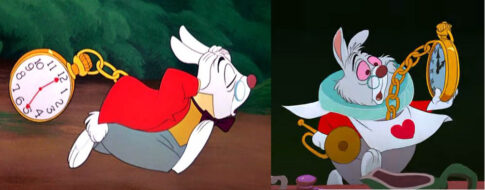
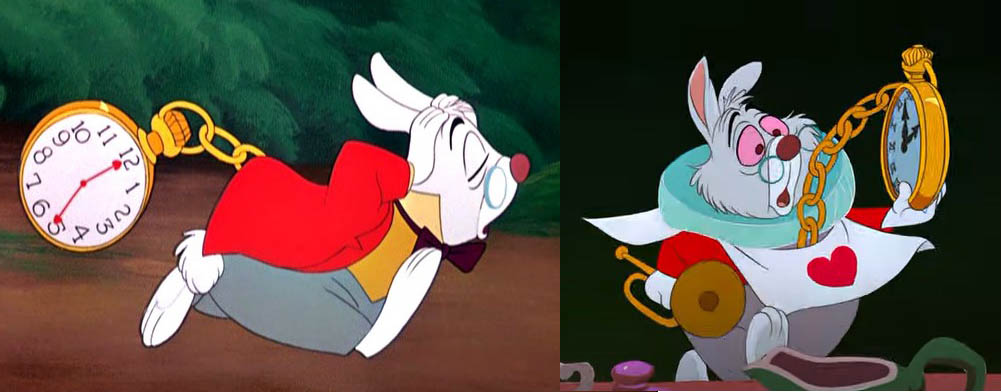
This is the part of the hammer scene, when the March Hare says: “I have an excellent idea! Let’s change the subject!”. Then, he hits the Mad Hatter with his hammer. He can only do this when he is sitting next to him, so probably that’s why the Disney people have juggled with that part. - When the White Rabbit appears at the Mad Tea Party, his pocket watch has changed. The hands are different and the numbers are now roman numbers. It could be either a goof-up, or perhaps the Rabbit did not only change his outfit but also his pocket watch?
- When Alice is lost in the wood some momeraths suddenly change color. Look at the bottom left corner when she sings “the waiting makes me curious”; a green momerath turns
orange and an orange one turns green for a split second. When zooming in at Alice another green one turns pink while the pink one turns green! (discovered by Kelvin Cedeno) - When Alice is playing croquet with the Queen and the King waves with his crown you hear someone shout: “Hooray!” Some people say that this is the voice of Mickey Mouse…

View pictures (screencaptures) from this movie
