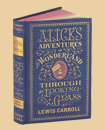
Alice in Wonderland and Philosophy: Curiouser and Curiouser
Availability:
Lenny's description:
“Alice in Wonderland and philosophy” is a book that contains 14 essays by different authors, that all deal with certain philosophic questions, and try to explain them with, or relate them to, passages of the Alice in Wonderland stories.
Some authors have good knowledge of the ‘Alice’ books, and explain parts of the story by relating them to philosophical problems. Others seem to have done it the other way around: they wrote their essay, using a philosophical issue as their starting point, and then appeared to have looked up some matching parts in the books to illustrate the issue.
This causes some small factual mistakes, like the editor referring in his introduction to the Red Queen as the one who orders beheadings, instead of the Queen of Hearts. And Mr. Knepp telling us that Alice “is desperately trying to leave” Wonderland, after she “attack[s] the members of the court“ – which is more a description of the ending of Disney’s cartoon adaptation, than the ending of the book.
Still, the book is interesting. Don’t expect thorough analyses and scholarly language, but easily readable essays that introduce you to the questions philosophers like Locke, Socrates, Plato and Nietzsche dealt with. Read it for your enjoyment, if you have some interest in philosophy and the Alice in Wonderland books. Or, if you are a student looking for inspiration for a thesis or school paper, use it as a starting point for your own philosophical analysis of the ‘Alice’ books.
The book consists of four parts, arranging the essays by the philosophical problem they deal with. These are the essays you will find in the book:
Unruly Alice: A feminist view of some adventures in Wonderland – by Megan S. Lloyd
Unlike other fairy tale heroines, Alice does not need the help of a good fairy godmother or a man, to make her way through Wonderland. This essay explains how Alice can be seen as a strong, independent, and assertive woman, and what she thinks of motherhood.
Jam yesterday, jam tomorrow, but never jam today: on procrastination, hiking, and… the Spice Girls? – by Mark D. White
Strangely enough, when looking back at some things, you will remember them as having been rewarding and fun, and you will expect them to give you pleasure in the future as well, but you never really enjoy them at the moment you’re doing it – like your job, and parenting. White tries to explain why this ‘Jam yesterday, jam tomorrow, but never jam today’ situation can still give you a positive feeling. He also shows why this principle causes (and solves the problem of) procrastination, and uses a very amusing style of writing to do so.
Nuclear Strategists in Wonderland – by Ron Hirschbein
A somewhat confusing and boring essay about the language, nonsense and non-logic (apparent contradictions), that are being used by the MAD tea party (nuclear strategists) to describe the theory of Mutually Assured Destruction (which arose during the Cold War). Which is like trying to describe things we don’t know anything about, because they have never actually happened.
“You’re nothing but a pack of cards!”: Alice doesn’t have a social contract – by Dennis Knepp
Explains why, unlike Socrates, who accepted his own death verdict, Alice does not have a ‘social contract’ with the inhabitants of Wonderland and is therefore not subject to their laws.
“Six impossible things before breakfast” – by George A. Dunn and Brian McDonald
What ‘nonsense’ is and isn’t, is determined by the society you’re part of. What we think is nonsense, is perfectly acceptable to the creatures that live in Wonderland. Things that seem to be logically impossible, don’t really have to be impossible – we just haven’t experienced them yet. Logic also exists in Wonderland, but they have their own kind of logic, and they use it to overthrow the reasonable.
Reasoning down the rabbit-hole: logical lessons in Wonderland – by David S. Brown
We use our experiences to discover cause and effect. Using logic, we arrange and structure our experiences, so we can think in a structured way and prevent fallacies. The article contains lessons in logic, and examples of wrong assumptions, wrong definitions, faulty categorizations, the confusion of subjects and predicates, and the confusion of sufficient and necessary conditions.
Three Ways of getting it wrong: induction in Wonderland – by Brenda Shea
This article illustrates three inductive problems Alice encounters:
1. Based on the experiences outside of Wonderland, she cannot predict what happens in Wonderland.
2. It is hard to determine and prove the basic nature of Wonderland. Is it a dream? It is caused by someone else?
3. She has trouble determining what the inhabitants of Wonderland mean with their words.
To solve these problems, Alice cannot use deduction (reasoning based on facts), but has to use induction: making predictions by inferring information about unobserved events or objects from those she has observed. Which leads to the problem that she always risks being wrong. And as she cannot prove her predictions, it is very hard for Alice to convince the Wonderland residents that their predictions are wrong.
Is there such a thing as a language? – by Daniel Whiting
It is often thought that language is a system, in which the meaning of expressions is being determined by rules. However, we also often use expressions of which we have not learned their meaning before, or that cannot be interpreted, but which are still being understood by others. Still, apparently we need (knowledge of) certain rules, to be able to understand unknown words. So there is such a thing as ‘language’, only in a slightly different way than philosophers often thought.
Alice, perception, and reality: Jell-O mistaken for stones – by Robert Arp
What makes something real? What is reality? This essay describes the relationship between perceiver, perceptions, and external objects (the reality). Is there such a thing as an objective, real world, or is the world constructed by your own perceptions?
How deep does the rabbit-hole go?: drugs, and dreams, perception and reality – by Scott F. Parker
As it seems to have become obligatory to relate the ‘Alice’ stories to drug use when trying to interpret them, this book also contains an essay about the subject. It isn’t about how the story is supposed to be inspired by drug use. It is about the impact drugs can have on perception and knowledge of the reality, and therefore how the story can be seen as a drug trip.
Under certain circumstances, you can experience reality in a different way – what seems to be normal to you, doesn’t actually have to be. At that moment, you cannot be sure whether you are perhaps dreaming, or under the influence of drugs, so you should always consider the possibility that we are all mad.
Perspectivism and tragedy: a Nietzschean interpretation of Alice’s Adventure – by Rick Mayock
To be able to create a ‘truth’, we will often have to accept several illusions and falsities first, to enable our brain to create structures in the chaos surrounding us. We never discover the truth, but we create it ourselves, by choosing, selecting, and simplifying our ideas about the world. This also means there is no ‘I’; even your own being is subject to continuous changes.
Wishing it were some other time: the temporal passage of Alice – by Mark W. Westmoreland
This essay deals with questions related to the concept of ‘time’. What is time? Is it something external to us? A substance? A mental construct we expose over the world to make sense? Was is already there when the world came into existence?
Serious nonsense – by Charles Taliaferro and Elizabeth Olson
How far can nonsense be stretched until it is no longer humorous or insightful? Alice has to remain her sensible, rational and curious self, to allow the humor to contrast with her sanity. This way she can point out the nonsense to us, while making sure the strange situations she finds herself in remain amusing, instead of threatening.
“Memory and muchness”: Alice and the philosophy of memory – by Tyler Shores
Your memory is crucial to define yourself as a self-conscious, thinking being, and to understand who we are - by ourselves, and in relation to others. What happens when you lose your memory? And what happens when you are living backwards, with a backwards memory?
Product details:
Seller name: (Shipping rates and seller details)
Item number (ASIN):
There are no visitor reviews available at this time.
Add your own review!


View cart / Checkout

In association with Amazon.com since 1999