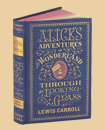
Alice's Adventures: Lewis Carroll in Popular Culture


List Price: $29.95
Price: $27.09
You Save: $2.84 (9%)


Availability: Usually ships in 1-2 business days


Lenny's description:


Seller's description:
Will Brooker, author of Batman Unmasked and Using the Force, turns his attention to Lewis Carroll and Alice. He takes the reader through a fascinating and revealing tour of late 20th Century popular culture, following Alice and her creator wherever they go. Brooker reveals the ways in which this iconic character has been used and adapted, taking in cartoons, movies, computer games, theme parks, heritage sites, novelisations, illustrations, biographies, theatrical performances, toys and other products, websites, fan clubs and much more. The result is a remarkable analysis of how one original creation has expanded over time to symbolize many different things to many different people.


Product details:

Item number (ASIN): 0826414338
Author: Will Brooker
Dewey Decimal Number: 823.8
ISBN: 0826414338
Manufacturer: Continuum
Number Of Items: 1
Number Of Pages: 384
Package Dimensions: 90 x 600 x 890 (hundredths-inches)
Publication Date: April, 2004
Publisher: Continuum
Binding: Hardcover


Reviews from Lenny's visitors:
There are no visitor reviews available at this time.

Add your own review!


Amazon.com customer reviews:

Average Rating: 4.0 out of 5 stars


Rating: 3.0 out of 5 stars - Nice, but dry
This book is what is says, a review of Alice and the way people understand it. If that interests you, this is a good book. For a Carolinian who just wants to see about the effects, but not get too far into the detail, this book is too dry. Too much time spent on American Mcgee's Alice, and the nuances are borderline psychobabble. This might be better for a research document on the subject as the points are valid, just not that interesting. I'm almost done reading the book. I'm trudging through more to "finish it" for the sake of finishing it, rather than out of interest. I'd recommend this book for skimming. ----- 1/23/10 Finally finished the book. The last two chapters are more interesting. In the penultimate, he analyzes responses from society members. It's odd, but it rings true. The final chapter is interesting, in that it has a different feeling than the rest of the book. Whereas in the rest of the book he studies from the outside--even when joining the society it is for the book--the final chapter is his tour of Alice sites. Will Booker is no longer the researcher, but the interested patron. It's as if before he left the scene, he decided to get into it once himself, just to have done it. But the sites he visited were lackluster, and the interest was just not there. His tone is sort of bittersweet, and i almost wished i was there to share it with him. In a strange way, he was going on his pilgrimage for our sake, and found nothing worth our time. His final analysis of what he would tell Carrol (not what he said he would actually say, but his study of it when he thought about it) seemed so true. This doesn't change my impression of the book overall. But i do think the final chapter is ironic. It is doubtful it will mean anything to anything who hasn't read the rest of the book, but i read the entire book and i finally got to the last chapter, and what i found was as unrewarding as the very pilgrimage he himself recorded there. I don't mean to knock the author. If i saw him, i'd thank him for the book and (hopefully) have a good talk with him. But for the book itself, it's interesting but dry.


Rating: 5.0 out of 5 stars - A Wasp Without a Wig
Will Brooker is the handsomest former nerd in central London, and he takes his own edge off by cligning to the little bit inside him that still feels rejected, neglected, and put on the shelf by the cooler kids. His analysis of Alice in Wonderland and Through the Looking Glass feels like something actually felt, not just abstracted, and it's clear that he keeps taking down from the hook all these various interpretations of Lewis Carroll's character, unable to settle on one, to see which one fits him the best. He is relentlessly modish and thoroughly up-to-date, and yet an old-fashioned drive for completion gives his character an uncharacteristic burnish, an OCD shadow. His book is terrifically written, on a sentence by sentence basis, but after awhile it does get wearisome, usually because like a handful of other practitioners of deconstructionist theory, Brooker is unable to give another full credit without sniping away at him or her. Every text that he picks up to examine will be revealed to have some huge flaw which Brooker doesn't share in. He's divided his study into nine general areas, from representations of Lewis Carroll in recent biography, to the fandom with which his own recent work has been concerned. At least one of these topics, the section in which he critiques many illustrators of Lewis Carroll, should have been jettisoned for, despite what he thinks, Brooker lacks the ability to write well about the visual arts, odd for one who has written extensively on many comic artists, but alas, he's pretty bankrupt there. Another chapter devotes itself to contemporary sequels to ALICE, including Jeff Noon and Gilbert Adair, and here again a weakness in Brooker's comprehensive approach becomes obvious at once: although he has just about nothing to say about Adair's ALICE THROUGH THE NEEDLE'S EYE, he feels obliged to "cover" it with the same word count as he does everything else. Against these minor flaws Brooker's book is an arsenal of critical insight and, as well, sheer writing chops. His opening salvo, tearing apart a series of biographers for their outright misstatements and lack of perspective, could hardly be better planned nor achieved. I would never have thought of the simple method he winds up using, which is, he isolates five areas of mystery in Carrollian biography, and one by one he examines what X, Y, or Z says about each. For example, what of the cut diary pages? What about the heartfelt diary entries which entreat his God to make him a more decent man? And what about those nude photographs of little boys and girls? OK, maybe he tries to do too much, and depends on his own adorableness for pages at a time, but this is a thoroughly exciting book and I hope Brooker sees fit to keep it up to date in the years to come, maybe staging an Alice Biennale or something like.


Rating: 5.0 out of 5 stars - The analysis juxtaposes perfectly with his life and times
Lewis Carroll wrote "Alice In Wonderland" and is most noted for this achievement, but he did so much more, fostering the setting for later computer games, theme parks, and performances inspired by his works. Alice's Adventures: Lewis Carroll In Popular Culture isn't just another coverage of Carroll's life; it's a survey of how the characters he created live on in modern times, adapted since his death in 1898. The analysis juxtaposes perfectly with his life and times and creates for more depth in the analysis of Alice's ongoing effects on modern culture, than the modern biography could achieve.


Rating: 5.0 out of 5 stars - IMAGES OF ALICE
Possibly the 60s were the time when Alice began to enter the popular culture.In 1963 for example there was a girl singer who named herself Alice Wonderland and made a single.A month or two earlier Neil Sedaka had landed Alice on to the Top 40. A matter of months later,as the Beatles began to conquer America,came John Lennon's 2nd book,like the first,influenced by Lewis Carroll's nonsense writings. (Carroll would be further immortalised by the Beatles when he was one of the figures on the Sgt Pepper sleeve). Then came the first rumblings of the new American music influenced by both the Beatles and folk music in general.The Great Society were one of many trying for a bite of the cherry and lead singer Grace Slick wrote a song called "White Rabbit",more or less a comment about parents who gave their kids Alice books then wondered why they ended up taking drugs. (Obviously tongue in cheek as Slick took more than her share during the Jefferson Airplane years:this was the band who she joined after the Great Society taking with her the 2 songs they'd recorded ,one of which was "White Rabbit". The rest is history. Alice has always been at least of enough fascination to the music world as to have inspired no end of songs or band names from "Alice In Sunderland" to the Mock Turtles,Carolyn Wonderland or even the very title of the 2nd book ALICE THROUGH THE LOOKING GLASS,who were a duo from the village of Ditchling in Suffolk and who wrote some music for a local Alice production. The album was a limited edition and is now worth over £1000 as its regarded as Folk Rock or whatever but even the reissue is worth quite a bit Someday the definitive book may be written about the Alice influence on popular music but meanwhile there's this one


Rating: 1.0 out of 5 stars - what is it saying?
not sure what this book is supposed to be. It is really just a rehash of very old ideas about Carroll with some pop culture uncomfortably tacked on. The 'myth' has been dealt with far better by people who really seem to understand it (it's too deep I think for Brooker's milieu), and the pop culture is presented without any kind of analysis or penetration.I think you are better off with Leach's 'In the Shadow of the Dreamchild' or Sigler's 'Alternative Alices'.


Similar items suggested by Amazon:


Alternate Versions:


Back to the previous page

View cart / Checkout

Customer service:

About this webshop

Shipping costs

Return policy

Payment methods

FAQ

Privacy & security


Safe shopping:

In association with Amazon.com since 1999

All purchases are covered by Amazon's A-to-z Guarantee purchase protection


Search for items: